Skip to content

Free Tool · No account required

How many solar panels do you need?

List what you want to run and the planner sizes the panels, batteries, inverter and charge controller for your location's darkest month. You get a parts list with a rough cost.

  • Real NREL sun data
  • Sized for the worst month
  • Itemized parts estimate
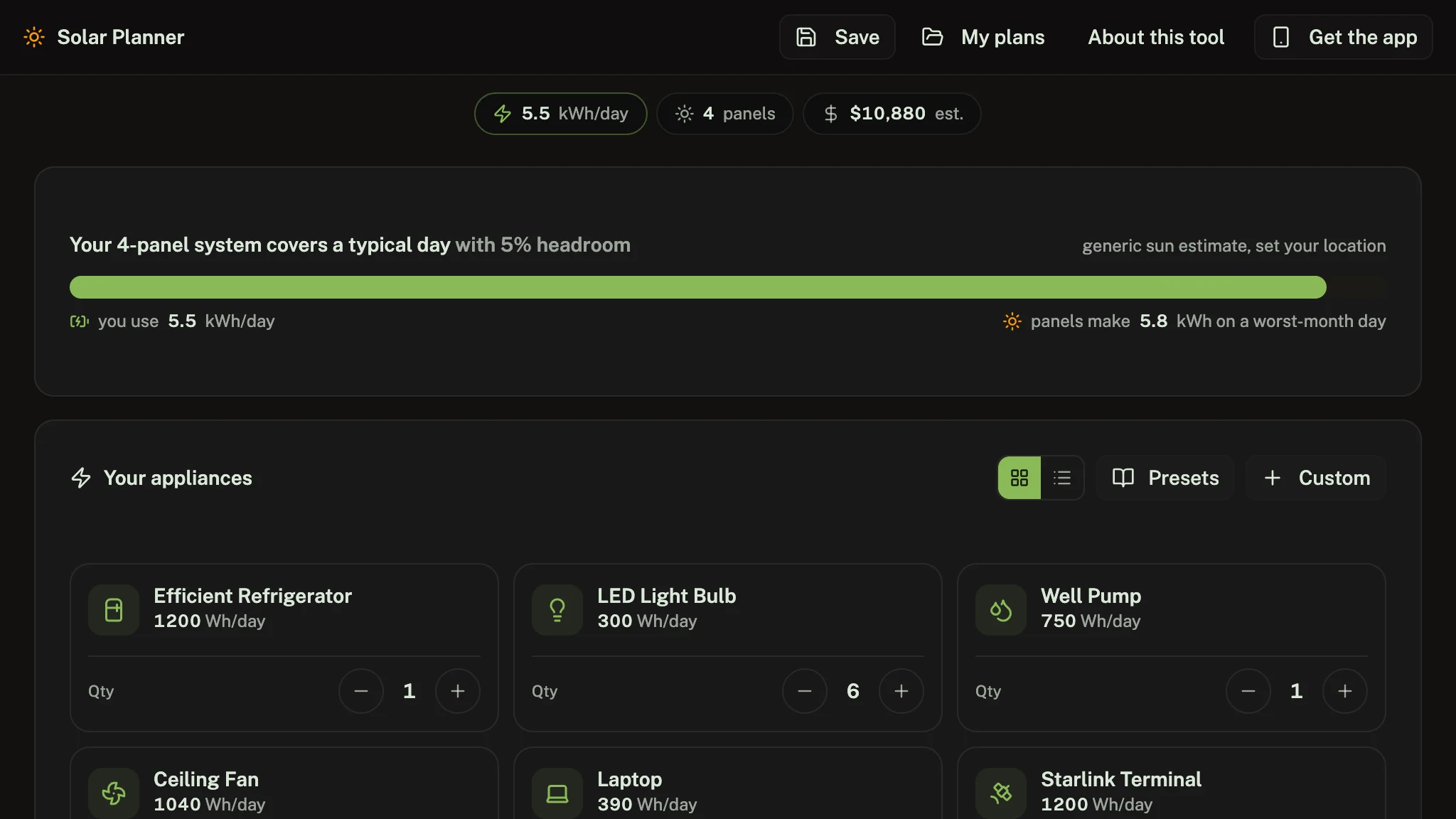
The solar planner: a full-time homestead load list with a refrigerator, well pump, Starlink terminal, laptop, ceiling fans and LED lights, totalling 5.5 kWh a day, above a coverage bar showing a 4-panel array carrying that load on a worst-month day
A real plan in the planner: a full-time homestead running a fridge, well pump, Starlink and lights at 5.5 kWh a day, sized to a 4-panel array with the equipment estimate alongside.

How it works

How the sizing works

  1. 1

    List what you'll run

    Pick from presets like a fridge, well pump, mini-split and Starlink, or add your own. Watts × hours × quantity adds up to your daily kWh and peak load.

  2. 2

    Set your system and location

    Choose system voltage, battery chemistry (LiFePO4, AGM or lithium-ion), panel size and days of autonomy. Drop a pin on your land to pull its month-by-month sun from NREL.

  3. 3

    Read the sizing

    The array is sized for your darkest month so it carries through winter. Batteries, inverter and charge controller come with it, matched to real gear for a starting budget. Your inputs stay in this browser.

Sun data from NREL PVWatts. Everything runs in your browser, with no account and no quote form.

Common questions

Solar sizing questions

Yes. The River Ranch Hub solar planner is free and runs entirely in your browser, with no account, no email wall, and no quote form. It sizes panels, batteries, inverter, and charge controller from your appliance list and real sun data.

It depends on your daily energy use and how much sun your location gets. List your appliances and the planner totals your daily kWh, pulls month-by-month irradiance from NREL PVWatts for your build site, and sizes the array for the worst month so it carries through winter.

The planner sizes your battery bank from your daily load, your days of autonomy, your system voltage, and your battery chemistry (LiFePO4, AGM, or lithium-ion), and sizes the inverter from your peak simultaneous demand.

Yes. When you set your build location it pulls month-by-month solar irradiance from NREL's free PVWatts model, so the sizing reflects the sun your land actually gets rather than a national average.